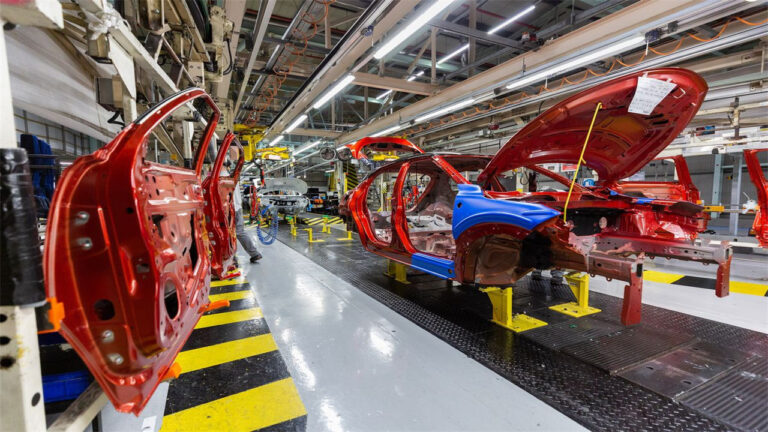
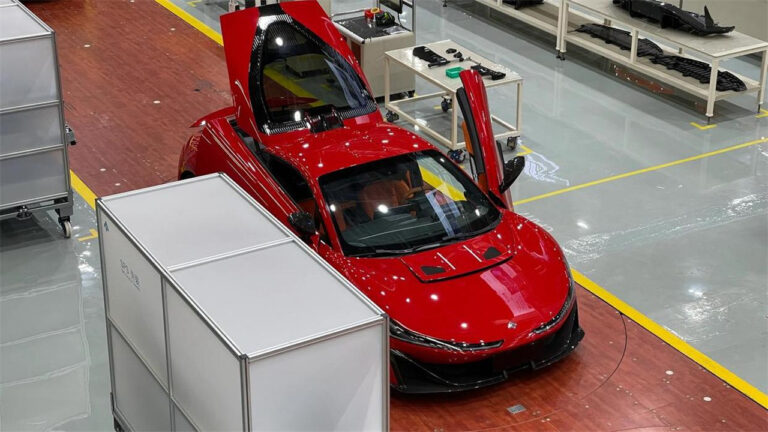
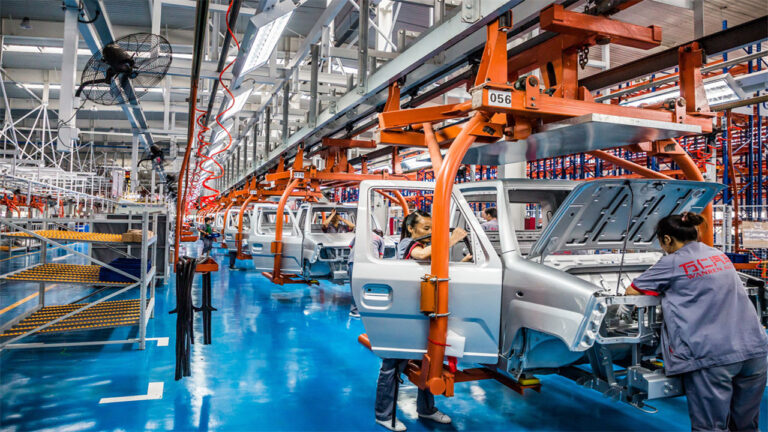
SUV Production Line—Production Line Factory from China

Automobile Production Lines/Assembly Lines are Suitable to Assemble/Produce 4 wheelers, Cars, Sedans, SUVs, Automobiles, EVs and so on.(Sometimes, suitable for Pickups production.)
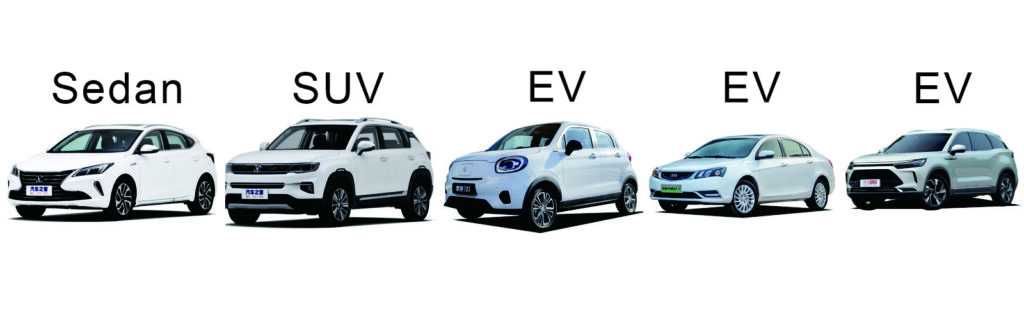
Modern SUV production lines share many core principles with sedan production (such as automation and lean manufacturing), but they also possess distinct characteristics due to the nature of SUV products. Below are their main features:
1. Production Line Hardware Designed for Larger Size and Weight
- Larger Tooling and Equipment: SUV bodies are taller, wider, and heavier. Consequently, the welding fixtures, body carriers, robot reach, and lifting equipment used on the production line must be scaled up in size and load capacity.
- Reinforced Manufacturing Processes: To meet the higher safety and load-bearing requirements of SUVs, the production line employs:
- More weld points and longer welds: To enhance body structural rigidity.
- Broader use of high-strength steel and hot-formed steel: Stamping and welding equipment must be capable of handling these stronger materials.
- Extensive application of structural adhesives: Works in synergy with welding to improve overall body strength and sealing.
2. Assembly Processes Adapted for Complex Functional Configurations
- Integration of Four-Wheel-Drive Systems: The production line requires dedicated workstations and equipment to install components like the rear axle drive unit, propeller shaft, and transfer case, increasing assembly complexity and time.
- Specialized Suspension and Chassis Installation: SUVs often feature more complex and robust suspension systems (e.g., multi-link independent suspension) and higher ground clearance. The line requires corresponding equipment to precisely install these larger, heavier chassis modules.
- Diverse Functional Configurations: The SUV market is highly segmented, with numerous customer options (4WD/2WD, different wheel sizes, off-road packages, towing packages, etc.). This demands extremely high flexibility from the production line.

3. Ultimate Flexibility and Mixed-Model Production Capability
- Platform Sharing and Co-production: To reduce costs, most SUVs are produced on the same line as sedans or MPVs sharing their platform. This requires the production line to have:
- Automatic Model Identification Systems: Using RFID or vision systems to identify different models and call up the corresponding assembly program.
- Programmable Flexible Fixtures: In the body shop, fixtures can automatically adjust their positioning to clamp bodies of different sizes.
- Highly Flexible Logistics Systems: Ensures the correct parts arrive at the workstation in sequence for the corresponding vehicle model.
4. Specialized Final Inspection and Validation
The inspection area at the end of an SUV production line typically includes stricter and more function-specific tests than those for sedans, to verify claimed off-road capability and reliability:
- Steep Grade Test: Checks the vehicle’s hill-climbing ability, hill-start assist, and hill descent control functions.
- Water Wading Test: Verifies body sealing and waterproof performance.
- Undulation Road Test: Checks body rigidity, suspension performance, and for any abnormal noises on simulated rough roads.
- 4WD System Test: Simulates wheel slip on roller testers to verify the response speed and effectiveness of the 4WD/traction control systems.

5. Lean and Efficient Logistics Supply
- Modular Supply: To improve assembly efficiency, front-end modules, cockpit modules, door modules, etc., are widely used and installed as complete units.
- Precise Sequential Parts Supply: For parts closely tied to model configuration, such as seats, bumpers, and dashboards, suppliers must deliver them in sequence according to the production line’s vehicle order, ensuring error-free assembly.
In Summary:
An SUV production line is a concentrated embodiment of flexibility, specialization, and automation in modern automotive manufacturing. It is not only “larger and stronger” in hardware to adapt to the physical characteristics of SUVs but also “smarter and more agile” in software and management to handle complex configuration options and mixed-model production. Furthermore, it ensures unique functionality and reliability through specialized inspections.