How to Choose the Right/Suitable ATV Production Line?—SKD ATV(All-Terrain Vehicles) Production Line
This is a complex decision-making process that requires comprehensive consideration of multiple factors.
Here is a systematic decision-making framework to help you select the most suitable ATV production line:
Step 1: Define Your Positioning and Strategic Goals (Strategic Level)
This is the cornerstone of all decisions. You must first answer the following core questions:
- What is your market positioning?
- Premium Brand: Pursuing high performance, advanced technology, and unique design? Or
- Value Brand: Focusing on economy, practicality, reliability, and affordability?
- Niche Market Specialist: Concentrating on specific areas like youth ATVs, racing models, electric ATVs, or special-purpose vehicles (e.g., for firefighting, patrol)?
- What is your target production capacity?
- Low Volume / Pilot Production: Hundreds of units per year, for market testing or customized production.
- Medium Scale: Thousands of units per year, to meet regional market demand.
- Mass Production: Tens of thousands of units or more per year, targeting the global market.
- What is your budget range?
- This determines whether you opt for a new, high-end automated line, a refurbished second-hand line, or a semi-automated line.
Step 2: Evaluate Production Line Types and Technical Solutions (Technical Level)
Based on the positioning from Step 1, evaluate different production line solutions:
1. Line Scale and Level of Automation:
- Fully Automated Production Line:
- Suitable for: Mass production, pursuit of ultimate efficiency and consistency, manufacturers with ample budgets.
- Characteristics: Extensive use of industrial robots (for welding, painting, assembly), automated conveyor systems, AGVs. Requires huge investment but offers the highest production efficiency and low labor costs.
- Semi-Automated Production Line:
- Suitable for: The preferred choice for most small and medium-sized manufacturers, balancing efficiency and flexibility.
- Characteristics: Automation at key stations (e.g., frame welding, painting), with manual labor for other assembly stations. Moderate investment and good flexibility.
- Modular / Cellular Production Line:
- Suitable for: Low-volume, high-mix, and high-customization production models.
- Characteristics: Production is broken down into independent “cells,” easy to adjust and reconfigure, capable of producing different models simultaneously. Relatively flexible investment.
2. Core Process Equipment Selection:
- Frame Manufacturing:
- Robotic Welding vs. Manual Welding: Robotic welding offers better consistency, suitable for standard models. Manual welding is more flexible for complex or low-volume frames. Your positioning dictates the choice.
- Painting Line:
- This is one of the key investments. Requires a complete pre-treatment (degreasing, phosphating), painting (primer, topcoat), and curing system. Eco-friendly painting (powder coating, water-based paint) is the future trend but comes at a higher cost.
- Powertrain Assembly:
- The marriage line for the engine/motor and transmission requires high-precision tools and positioning equipment.
- Final Assembly Line:
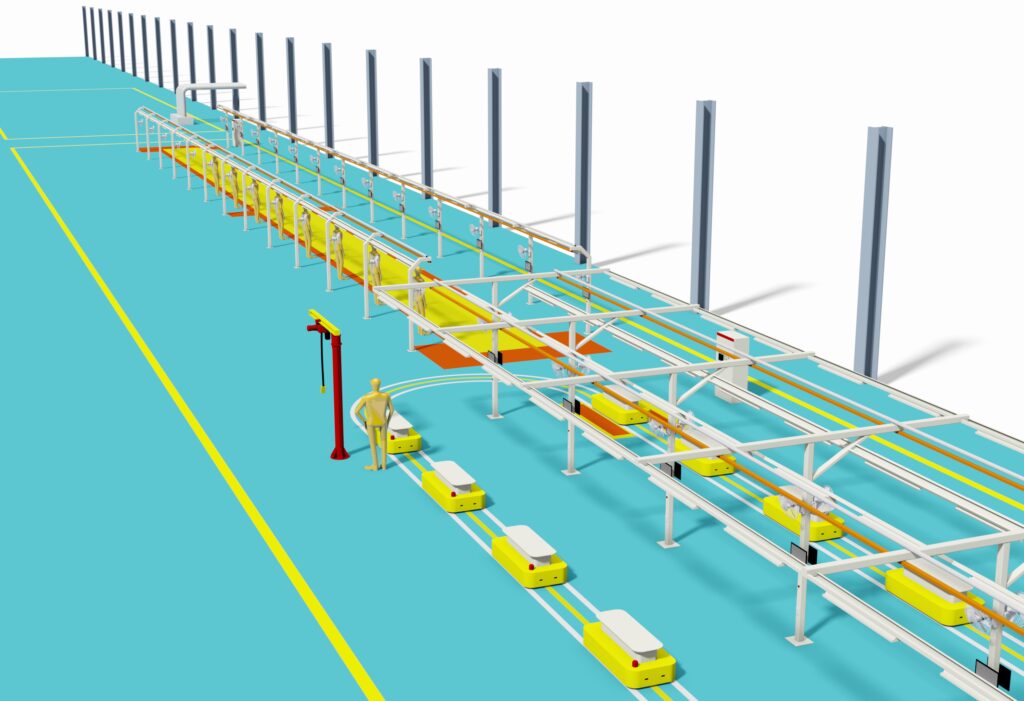
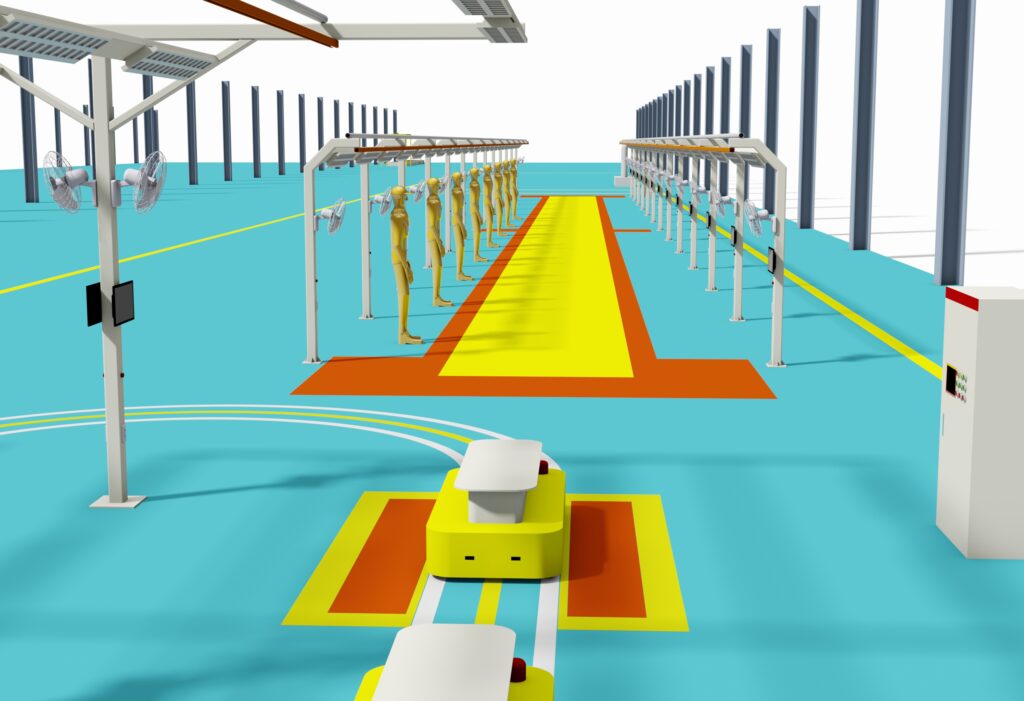
- Drag Chain vs. Skid Chain vs. AGV Smart Logistics: Drag chains are most common; AGVs offer the highest flexibility, enabling “station-to-vehicle” smart assembly, but with higher cost and complexity.
Step 3: Consider Key Support Systems (Support Level)
A production line is more than just hardware:
- Quality Inspection and Testing System:
- Must plan for online inspection (e.g., torque monitoring, electrical testing) and end-of-line tests (e.g., brake testing, water spray testing, test track). Quality is the lifeline of your brand.
- Supply Chain and Material Management System:
- The production line requires stable material supply. Consider component warehousing and line-side material feeding methods (e.g., Kanban, SPS) to ensure smooth production flow.
- Information and Management System (MES):
- A modern production line requires a Manufacturing Execution System (MES) to monitor production progress, equipment status, and quality data, enabling transparent and digital management.
Step 4: Conduct Due Diligence and Make the Decision (Execution Level)
- Supplier Selection:
- Source Multiple Suppliers: Include specialized non-standard automation integrators and established complete vehicle plant solution providers.
- Review Case Studies: Conduct site visits to review suppliers’ past successful projects, especially production lines for similar products.
- Assess Capabilities: Evaluate their technical team, after-sales service capability, and spare parts support.
- Cost-Benefit Analysis:
- Don’t just look at the initial investment; calculate the total cost of ownership, including: equipment depreciation, energy consumption, maintenance, labor, floor space, etc.
- Calculate the Return on Investment (ROI).
- Scalability and Flexibility:
- Is the chosen production line easy to expand in the future? Can it adapt to product model changes? Leaving room for upgrades is crucial.


