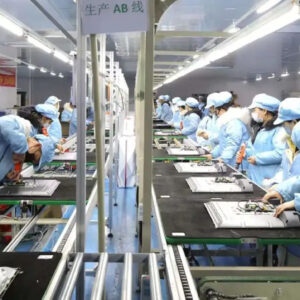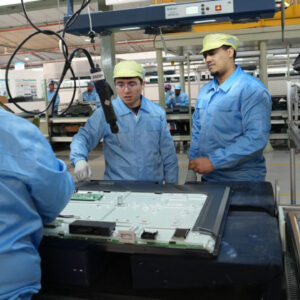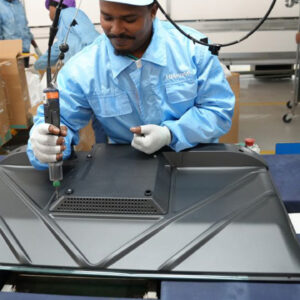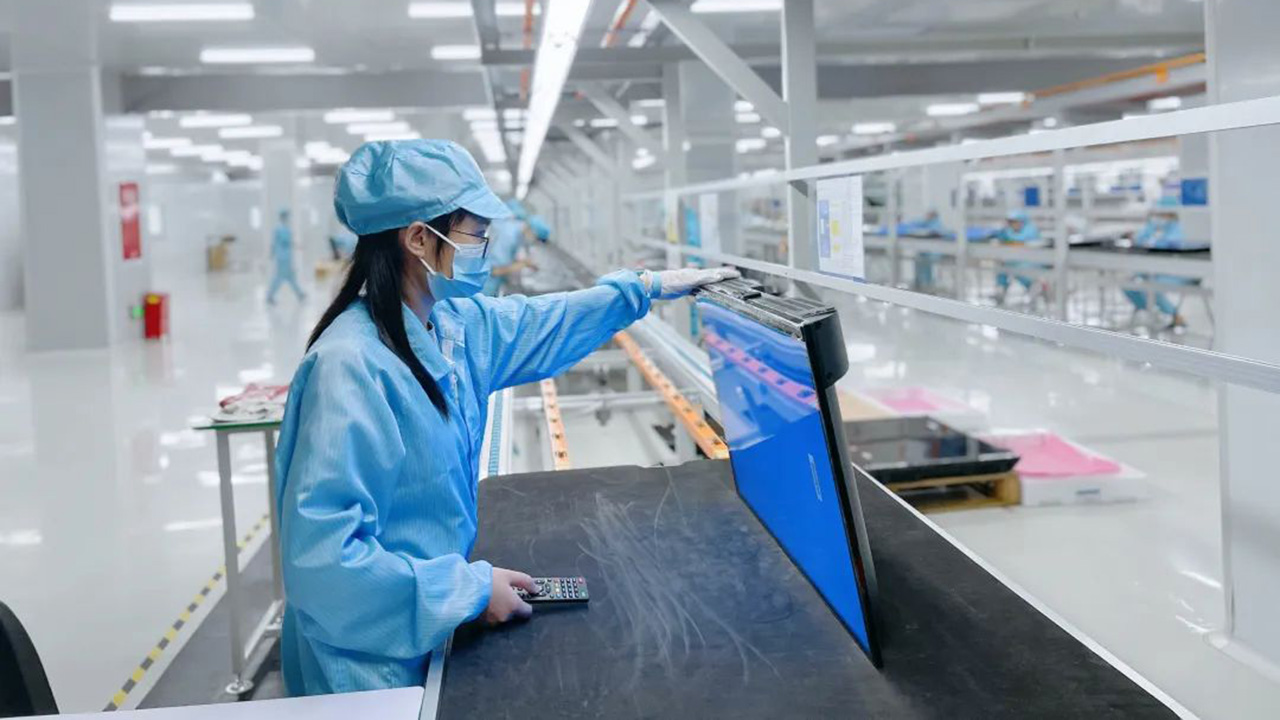
Chinese TV Assembly Line Factory—Experienced Assembly Line Manufacturer
Description
We are a professional manufacture of TV Assembly Line/TV Production Line solutions.
TV Assembly Lines/TV Production Lines are Suitable to Assemble/Produce following Televisions and TVs and so on.
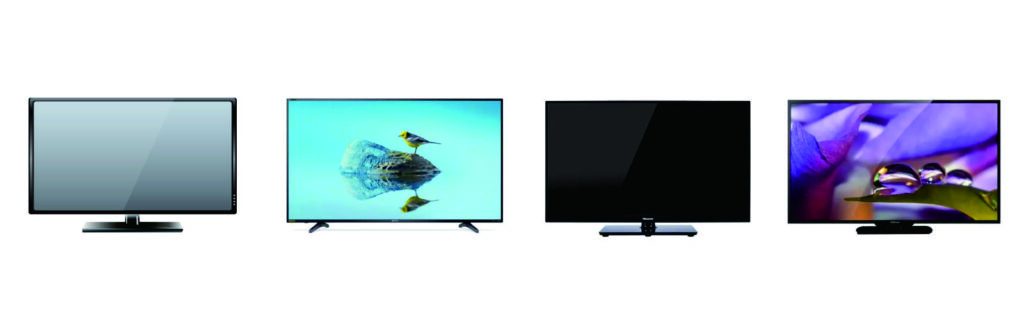
TV Assembly Line/Conveyor
Main Types and Characteristics
Depending on the process segment and requirements, the main types of television conveyance lines include:
1. Friction Roller Conveyor
Working Principle: Consists of a series of densely arranged rollers. All rollers are driven synchronously via friction rings or belts powered by a motor, using friction to move the televisions.
Advantages:
Smooth Operation: No impact, making it ideal for conveying large, fragile TVs.
High Load Capacity: Can withstand the weight of heavy televisions.
High Positioning Accuracy: Can be controlled by servo motors for precise positioning.
Application Scenarios: Ideal for the main assembly line and packaging line**, especially for automated assembly stations requiring precise positioning.
2. Belt Conveyor
Working Principle: Uses a motor to drive an endless loop belt, utilizing the friction between the belt and the product base for conveyance.
Advantages:
Smooth and quiet operation.
Relatively low cost.
Can be fitted with stoppers for positioning.
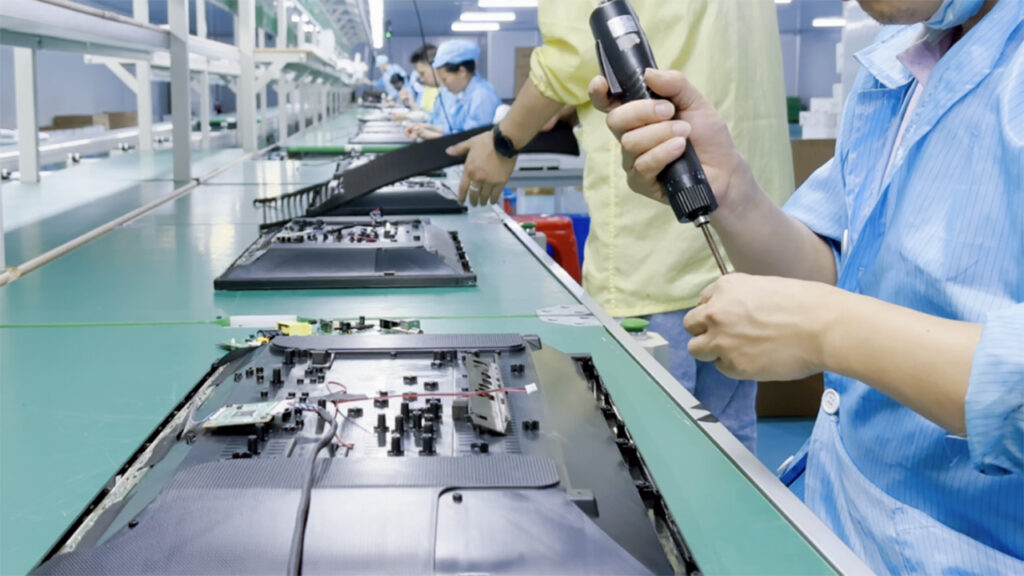
3. Slat Chain Conveyor
Working Principle: Comprised of metal slats connected in a series, driven by sprockets, operating in a continuous loop like a tank tread.
Advantages:
Extremely robust and durable , with very high load capacity.
Can withstand heavy loads and impact.
4. Lift & Transfer Unit & Turntable
Working Principle: These are not continuous lines but crucial transfer nodes . A lifting mechanism raises the TV from one line, and a transfer mechanism moves it laterally or rotates it (e.g., 90 degrees) before placing it onto another line.
Application Scenarios:
Line Diverting and Merging: Distributing televisions to different test or packaging lines.
Changing Direction: Enabling 90-degree turns from a straight line.
Process Transfer: e.g., Moving from the assembly segment to the testing segment.